
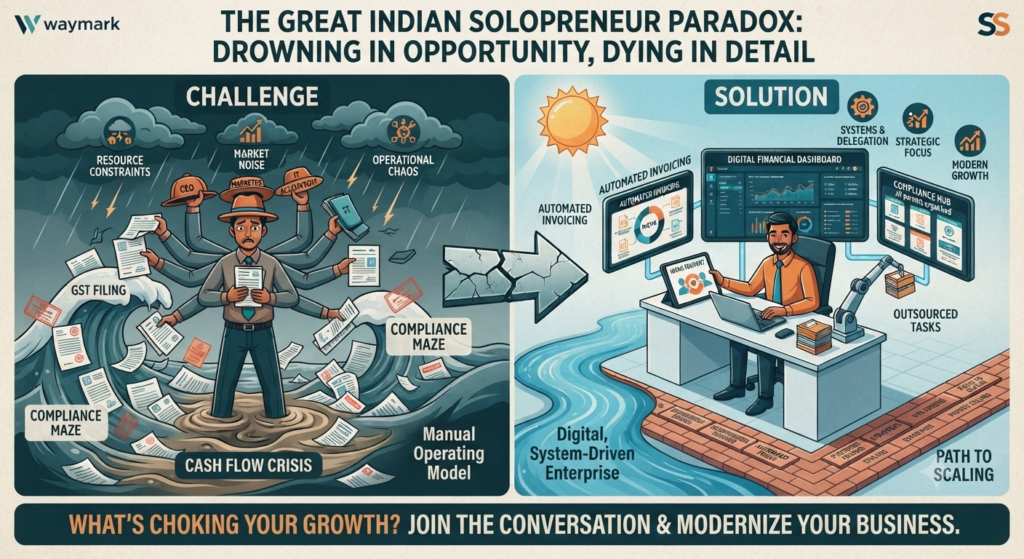
India has never been a better place to be an entrepreneur. Every day, someone starts a home bakery, launches a digital agency, opens a neighborhood retail store, begins consulting independently, manufactures engineering components, or builds a technology startup. Opportunities are everywhere.
Yet, for every inspiring success story, there are thousands of entrepreneurs quietly fighting battles that nobody sees. Not because their ideas are weak. Not because they lack passion.
But because they spend more time running the business than growing the business.
Whether you’re a solo entrepreneur working from your dining table or running a growing manufacturing unit with 200 employees, the struggle often looks surprisingly similar.
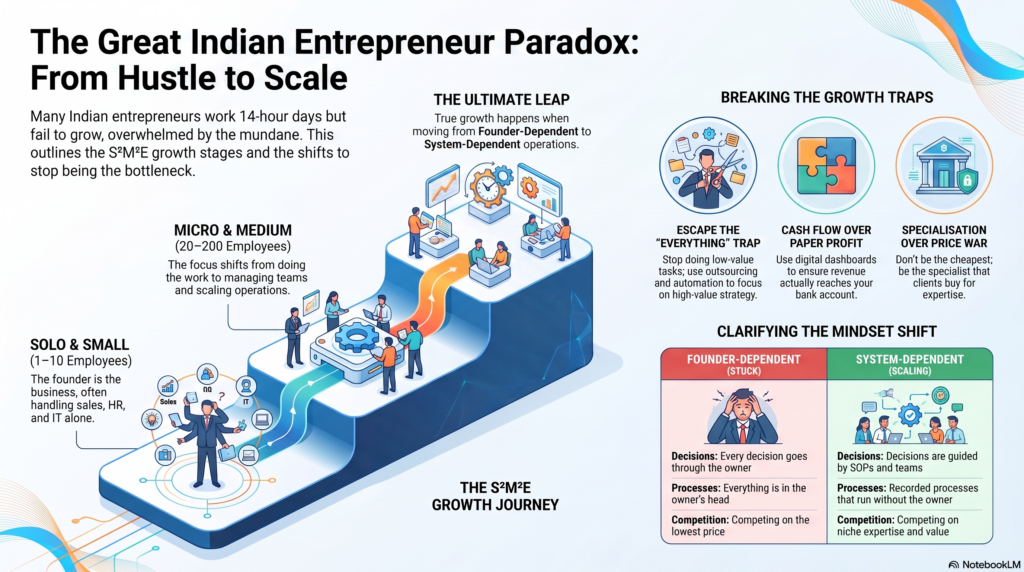
I like to classify businesses into what I call the S²M²E spectrum—Solo, Small, Micro and Medium Enterprises. Each stage has its own opportunities and its own set of headaches.
- Solo Entrepreneur (1 person): A freelance designer, digital marketer, business coach, content creator, architect, or home chef who is the business.
- Small Enterprise (2–10 people): A boutique marketing agency, neighborhood café, coaching institute, or specialty retailer where the founder still manages almost everything.
- Micro Enterprise (10–50 people): A garment manufacturer, IT services company, packaging business, cloud kitchen chain, or regional distributor beginning to build teams and systems.
- Medium Enterprise (50–250+ people): A manufacturing company, engineering firm, logistics provider, healthcare organization, or fast-growing technology company now dealing with scale, delegation, and governance.
Different sizes; Different revenue; Different complexity, yet, they all encounter remarkably similar paradoxes.
Paradox 1: The Entrepreneur Who Does Everything
Let me ask you a simple question. How many roles have you played today?
CEO?
Salesperson?
Accountant?
Marketing Head?
HR Manager?
Customer Support?
IT Helpdesk?
Operations Manager?
Delivery Executive?
If your answer is “almost all of them,” you’re not alone. This is especially true for Solo and Small Enterprises. A freelance consultant spends more time creating invoices than acquiring clients.
A café owner is buying vegetables in the morning, serving customers at lunch, managing Instagram in the afternoon, and checking GST filings at night.
A boutique retailer handles procurement, sales, customer complaints, payroll, and inventory—often in the same day.
Being resourceful is admirable.
Being responsible for everything isn’t sustainable.
Eventually, you become the biggest bottleneck in your own business.
What works?
Stop trying to become indispensable.
Instead: Outsource bookkeeping; Hire freelancers for design and content; Use virtual assistants; Automate repetitive administration; Focus on activities only you can perform.
Remember: You didn’t start a business to become its busiest employee.
Paradox 2: Sales Are Growing. Cash Isn’t.
One of the biggest myths in business is this: “We’re growing, so we must be doing well.”
Not necessarily. Many entrepreneurs proudly announce record sales…while struggling to pay salaries. Consider these examples:
A marketing agency completes projects but waits 90 days for payment.
A manufacturing supplier has ₹50 lakh worth of invoices outstanding.
A retailer has shelves full of inventory but very little cash in the bank.
Revenue is important.
Cash flow keeps businesses alive.
Across India’s S²M²E ecosystem, delayed payments remain one of the biggest reasons businesses struggle—not because customers don’t pay, but because they pay late.
What works?
Modernize your financial management — Digital invoicing[ Automated payment reminders; Cloud accounting; Weekly cash-flow dashboards; Better receivables tracking
The goal isn’t just increasing revenue. It’s shortening the time between delivering value and receiving payment. Cash flow is the oxygen of every enterprise.
Paradox 3: Growth Creates Chaos
Success creates a strange problem. The business grows…but the systems don’t. Initially, everything works because the founder knows every customer, every supplier, every employee, and every process. Then the business doubles.
Suddenly, customers receive inconsistent service, quality begins to fluctuate, employees ask the same questions repeatedly, decisions wait for the founder, and every small issue lands on the entrepreneur’s desk. This is where many Micro and Medium Enterprises hit an invisible ceiling. Growth without systems becomes organized chaos.
What works?
Document everything.
Create SOPs.
Standardize repeatable processes.
Delegate responsibilities—not just tasks.
Train people to manage systems instead of depending on your memory.
A scalable business shouldn’t collapse simply because the founder takes a week’s vacation.
Paradox 4: Building a Business… or Managing Compliance?
Every entrepreneur starts with dreams. Few imagine spending hours dealing with GST, TDS, labour laws, licenses, renewals, vendor documentation, statutory filings, and endless paperwork. c Yet compliance consumes an astonishing amount of entrepreneurial energy.
A consultant worries about GST returns. A retailer tracks multiple tax deadlines. A manufacturer manages factory compliance, labour regulations, pollution certificates, and audits. The larger you become, the more compliance follows you.
What works?
Don’t fight paperwork manually. Digitize it. Use: automated compliance reminders, cloud-based document storage, integrated accounting software, payroll systems, compliance dashboards. Technology doesn’t eliminate regulations. It prevents regulations from consuming your life.
Paradox 5: Competing in a Market Where Everyone Looks the Same
The Indian marketplace has never been more competitive. Every product has alternatives. Every service has dozens of providers. Every city has thousands of businesses competing for attention. Too many entrepreneurs respond by lowering prices. Unfortunately, that’s usually the quickest route to shrinking profits.
The better question is: Why should someone choose you?
Not because you’re cheaper, but because you’re different.
Consider these examples:
A chartered accountant focusing only on startups.
A café known exclusively for healthy millet-based meals.
A digital marketing agency serving only healthcare brands.
A manufacturer producing only precision components for electric vehicles.
Each has deliberately chosen a niche.
Instead of competing with everyone…
…they become the obvious choice for someone.
What works?
Own a niche; Build expertise; Develop authority; Create memorable customer experiences, as when customers value your expertise, price becomes only one part of the conversation.
The Real Shift
The biggest transformation isn’t from small to large. It’s from founder-dependent to system-dependent. The entrepreneurs who thrive over the next decade won’t necessarily work harder. They’ll build businesses that work smarter. They’ll automate routine work. Delegate intelligently. Use AI and digital tools effectively. Create repeatable systems. And spend more time thinking strategically than firefighting operational issues.
Over to You…
Where do you see yourself on the S²M²E spectrum?
- Are you a Solo Entrepreneur trying to do everything yourself?
- A Small Enterprise struggling to build the right team?
- A Micro Enterprise trying to scale without losing control?
- Or a Medium Enterprise balancing growth with governance?
And here’s the bigger question:
What’s the one challenge that steals most of your time every week?
Is it finding customers?
Managing cash flow?
Hiring the right people?
Compliance?
Marketing?
Or simply trying to do too many things at once?
Share your experience in the comments.
Because chances are, someone else is facing exactly the same challenge—and together, we might discover a better way forward.