
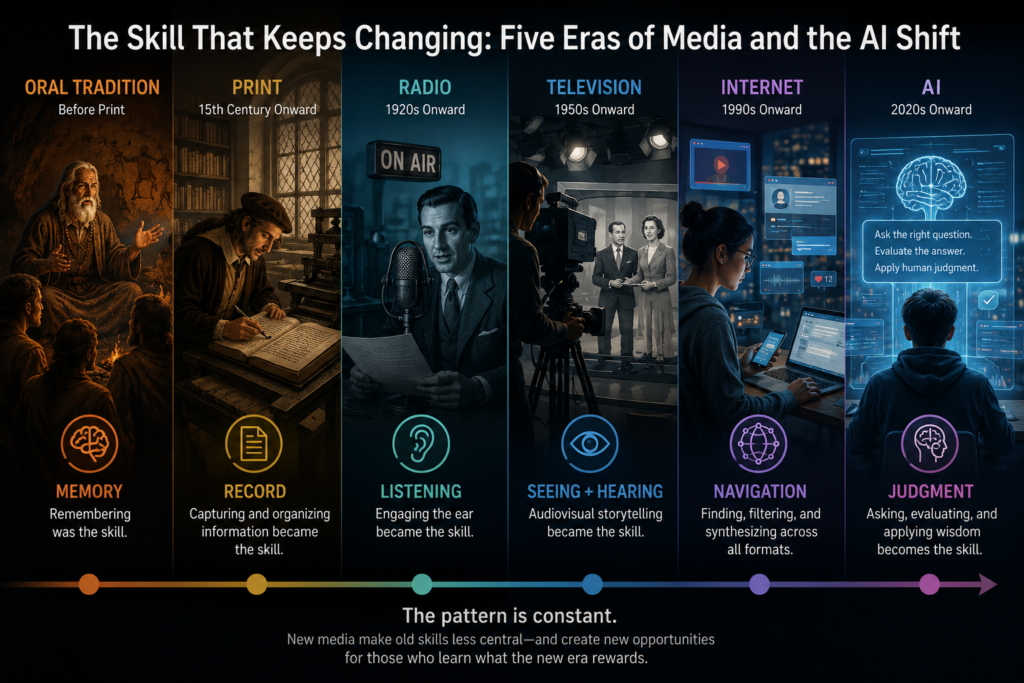
Before printing press arrived, memory would have a had different and traditional connotation and was the most valuable skill a person could have. Bards memorized epics. Priests memorized scripture. Apprentices memorized trades because there was no other way to pass them on. The mind was the only hard drive available, and entire careers — storyteller, town crier, oral historian — existed to serve that constraint. Then print arrived, and memory quietly lost its monopoly.
Print: From Recall to Record
When knowledge could be written and copied, the prized skill shifted from *remembering* to *noting* — capturing, organizing, and retrieving information from external sources rather than your own head. Print didn’t kill memory — bards still existed — but it stopped being the *central* skill. The career ladder moved.
This birthed entirely new careers: the scribe became the editor, the printer, the librarian, the journalist, the clerk. Education itself reorganized around reading and writing rather than oral recitation.
Radio: From the Page to the Ear
Print journalists who couldn’t adapt their writing to be *heard* rather than *read* struggled. Radio’s disruption was different. It didn’t just store information differently; it changed the sense you used to receive it.
Listening became the premium skill, and with it came announcers, radio dramatists, voice actors, and an entire advertising industry built around audio persuasion. A new literacy — pacing, tone, silence — became valuable almost overnight.
Television: From Hearing to Seeing-and-Hearing
Radio stars who couldn’t translate to screen often faded; those who could — think of how seamlessly some performers moved from stage to screen — thrived. TV layered sight back onto sound, and audiovisual fluency became the new currency. This created cinematographers, TV producers, broadcast editors, and a generation of advertisers who had to think in moving images, not just words or sound.
Each transition followed the same pattern: a new medium arrives, makes a previously elite skill less central, and creates new careers around whatever skill the new medium rewards. The disrupted didn’t disappear entirely — they specialized, or they adapted.
The Internet: Convergence, Not Just Another Layer
The defining skill of this era wasn’t memorizing, noting, listening, or watching alone — it was **navigating and synthesizing** across all of them at once, fast, often on a six-inch screen.
The internet did something the previous transitions hadn’t: instead of adding one more sense or one more format, it **converged all of them** — text, audio, video, and eventually real-time interaction — onto a single, searchable, infinitely copyable medium. And then the mobile phone put that convergence in every pocket.
This is why the internet era produced such a strange mix of careers: SEO specialists (a descendant of the librarian’s indexing instinct), podcasters (radio’s heir), YouTubers (TV’s heir), and social media managers (a bit of all of them, optimized for a feed).
So Where Does AI Fit?
Each prior shift moved the *premium skill* — from recall, to record-keeping, to listening, to watching, to multi-format navigation. AI is the next link in that chain, and it’s worth being precise about what it’s actually doing differently.
AI doesn’t introduce a new sense or format. It automates the synthesis step itself — the very thing the internet era trained us to do manually. If noting was print’s skill and navigating was the internet’s skill, AI’s era seems to be rewarding something one level up: **knowing what question to ask, and judging whether the answer is any good.**
That has visible career implications already underway. Roles built purely around retrieval or formatting — basic content aggregation, routine transcription, first-draft copywriting — are under the same pressure radio announcers felt when TV arrived.
Meanwhile, new roles are emerging around the skill AI can’t yet replace: framing problems precisely, verifying outputs, and applying judgment about context AI doesn’t have — prompt engineers, AI editors, and “human-in-the-loop” reviewers across law, medicine, and journalism.
The Pattern, Not the Panic
The honest lesson from five centuries of this isn’t that technology destroys careers — it’s that it **relocates value** to whoever can do the thing the machine still can’t. The bard didn’t vanish when books arrived; storytelling became a craft rather than a necessity. The radio announcer’s instinct for voice became podcasting’s backbone decades later.
History suggests the people who thrive aren’t the ones who cling to the old premium skill. They’re the ones who notice the shift early, and learn the new one before it becomes obvious to everyone else.
The way forward, then, looks less like resisting AI and more like asking the same question every generation before us had to ask honestly: *what is the new “memory” — the old, central skill that’s about to become optional — and what is the new “noting” I need to learn instead?*
Very nice site